
What is a Thermal Camera?
This is a question that may occupy the minds of professionals intending to include this device in their industrial toolset. In this article, we attempt to answer your questions and clear up ambiguities by introducing thermography cameras.
A Thermovision or Thermal Camera is a diagnostic tool used in Maintenance and Condition Monitoring (CM) processes. Essentially, any defect or fault in equipment that manifests as a temperature difference relative to its surroundings can be identified and tracked using these devices. This is because thermal cameras utilize the radiation emitted from machinery to create a thermal image.
How a Thermal Camera Works
If we look closely at the structure of these cameras, we see that they do not measure temperature directly. These cameras capture Infrared Waves emitted by an object. Based on configurations previously applied by the user—such as ambient temperature, distance to the target, and emissivity—the device performs the necessary calculations and displays the result as a temperature reading.
Common Misconceptions About Thermal Cameras
One of the most common misconceptions among some individuals is the belief that these cameras can see *inside* objects. This is completely false and has no scientific basis.
With a little study, one realizes that the Infrared Waves used for temperature measurement have lower energy levels than visible light. This low energy level means they cannot pass through glass or solid objects (unlike X-rays). Only a few materials, such as Germanium, allow infrared transmission.
If you need to inspect the interior of your equipment (e.g., an electrical panel) with a Thermovision camera, you must use Infrared Windows made of Germanium installed on the equipment.
Types of Thermal Cameras
Thermal cameras are categorized based on various criteria, but generally, they fall into three spectral bands:
Short-Wave:0 to 2 micrometers (µm)
Mid-Wave: 2 to 5.5 µm
Long-Wave: 5.7 to 15 µm
This classification is a good guide for selecting the right device for a specific industry. For example, standard thermography cameras can only display the thermal profile of solid and liquid surfaces; you cannot normally measure the thermal spectrum of gases with them. Therefore, experts use cameras with a limited/specific spectral band (Optical Gas Imaging) to detect gas leaks and temperature ranges.
Capabilities of Thermography Cameras
Today, Thermography is known globally as one of the modern methods for Preventive Maintenance (PM) and Condition Monitoring.Applications include troubleshooting electrical, rotating, and mechanical equipment, inspecting insulation in power plants, oil, gas, petrochemical, steel, and cement industries, as well as checking for heat loss in buildings and furnaces. It is also used in firefighting, medical, veterinary, and military fields.
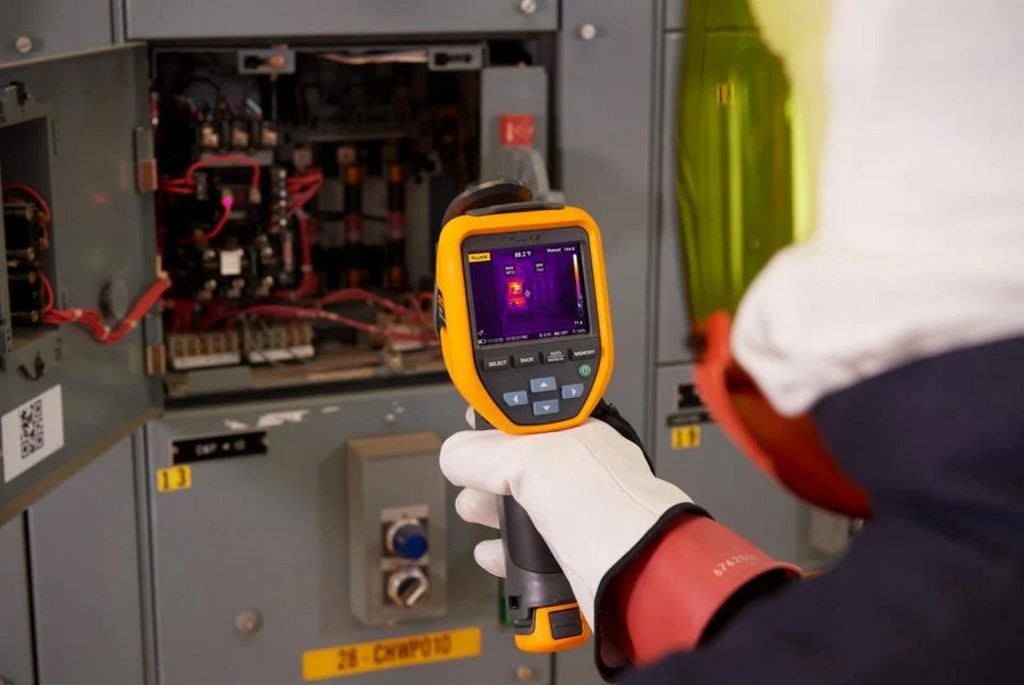
Thermal cameras act like an eye armed with an infrared sensor sensitive to heat radiation. By receiving and analyzing radiated waves, they allow experts to identify defective or suspicious areas.
The diversity of these devices stems from their varying specifications. The most important parameters include
Temperature Range
The range a camera can detect is vital. Most industrial cameras cover a minimum of -20°C or -30°C. The maximum range varies significantly:
Standard Range: Up to 350°C or 380°C (e.g., FLIR TG165, Testo 875).
High Range: Up to 550°C, 650°C, or higher (e.g., Testo 875-2, Testo 872/868, Fluke Ti401 Pro, HTI mobile-connected cameras)
Image Resolution
Users need clear images for analysis. Higher resolution equals better detail.
* *Example:* Fluke Ti400 (320×240 pixels) vs. Fluke Ti401 Pro (640×480 pixels).
Thermal Sensitivity (NETD)
This determines the camera’s resolving power. For example, a camera with a sensitivity of 0.03°C (30mK) allows the user to distinguish temperature differences as small as 0.03 degrees, displayed with distinct colors.
PIP (Picture-in-Picture)
This attractive feature overlays the thermal image onto the real visual image, facilitating easier location and analysis of the defect.

Emissivity
Emissivity is the measure of an object’s ability to emit infrared energy. It is the ratio of energy radiated by a material to energy radiated by a Black Body at the same temperature.
* A perfect black body has an emissivity of 1.
* Other objects have an emissivity less than 1.
* Non-metals usually have high emissivity.
* Polished metals (like silver, ε=0.02) have low emissivity, while oxidized surfaces emit more.
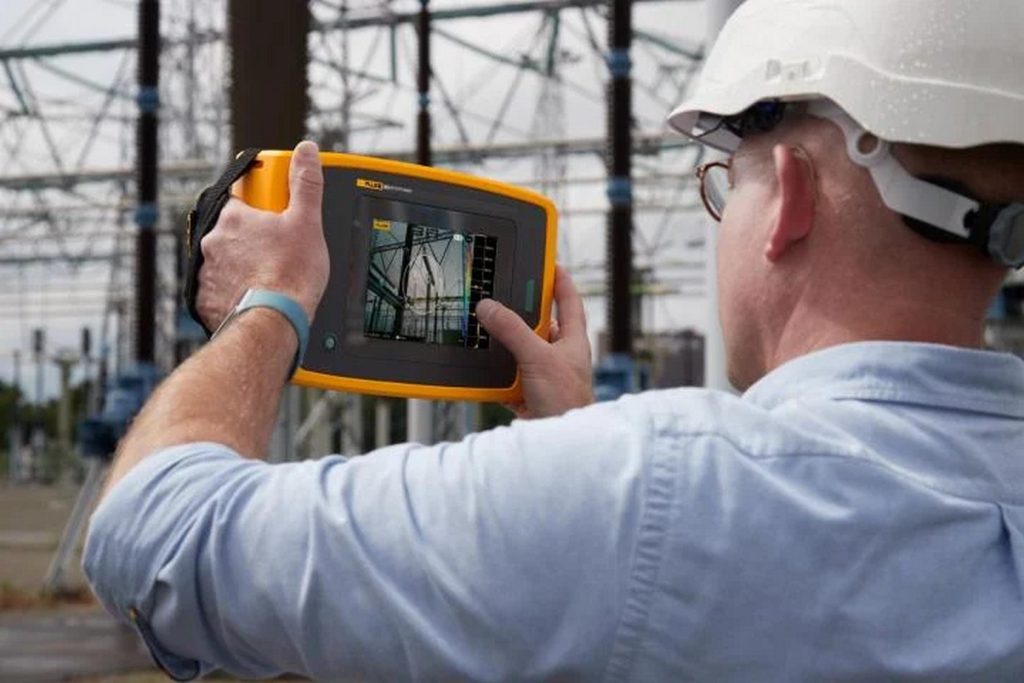
Important Criteria for Selecting a Thermal Camera
High price is not always the best criterion. A cheaper camera might be more suitable for specific environmental conditions. Here are key selection factors:
1. Detector Resolution: Higher thermal pixel count means higher accuracy and better imaging at distances.
2. Temperature Range: Must match the user’s application.
3. Field of View (FOV): Narrow FOV for long distances; Wide FOV for close-ups.
4. Thermal Sensitivity (NETD): Lower value equals better image quality and noise reduction (e.g., <30mK).
5. Focus Mechanism: Manual, Automatic (Auto-focus), or remote/computer-controlled.
6. Zoom Capability: Digital zoom is useful but may reduce image quality.
7. Spatial Resolution (IFOV): Smaller distance between pixels is better for long-range measurement.
8. Spot Meters: The number of spots, areas, and lines the user can place on the screen for simultaneous comparison.
9. Accuracy: Usually expressed as ±2°C or ±2%.
10. Fusion/Blending: Simultaneous display of thermal and visual images.
11. Heat Flux Measurement: Ability to measure heat transfer rates (advanced feature).
12. Area Measurement: Intelligent calculation of areas for deposits or corrosion.
13. Color Palettes: Different palettes (Ironbow, Rainbow, Gray) help in better analysis.
14. Panoramic Imaging: Stitching images together to cover large equipment without taking multiple separate photos.
15. Voice Annotation: Recording voice notes attached to the image.
16. Laser Pointer:To pinpoint the target physically during inspection.