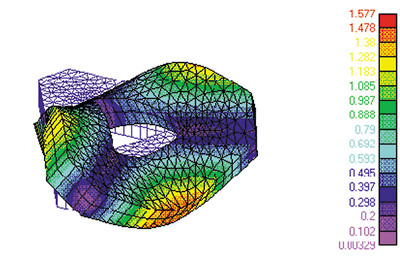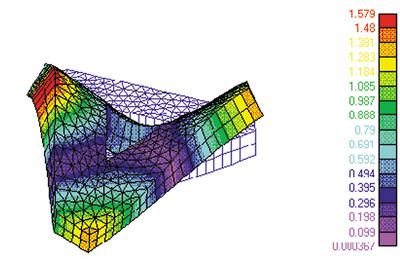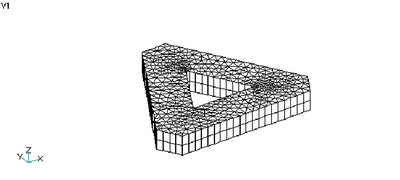
Noavaran Payesh utilizes Modal Analysis, Orbit Analysis, Torsional Analysis, and theoretical Operational Deflection Shapes (ODS) for the comprehensive diagnostic evaluation of the most complex and dynamic problems affecting rotating machinery.Specialized services in modal analysis and structural deformation are employed to identify resonance defects and rectify faults. With a successful track record of providing these specialized services across numerous projects, the company declares its readiness to offer the aforementioned services.Vibrating systems possess infinite degrees of freedom, natural frequencies, and corresponding mode shapes. Whenever an excitation frequency (such as forces from unbalance, misalignment, looseness, bearing issues, etc.) matches a natural frequency, resonance occurs.By performing modal analysis, the occurrence of resonance can be investigated. Furthermore, through ODS analysis, this destructive phenomenon can be prevented by identifying critical points and altering the system’s natural frequencies. It should be noted that this company performs modal analysis via both software simulation and impact testing.The rotating equipment vibration analysis program utilizes the latest hardware and real-time data software suites combined with theoretical “what-if” solutions. It modifies model structures until corrective measures can be generated, identified, and implemented.Modal analysis measures and analyzes the dynamic response of structures and fluids under vibrational excitation.Depending on the frequency of the excitation force, deformation patterns (bending, torsion) are generated, referred to as mode shapes (contours). An animated representation of these mode shapes is beneficial for diagnosing inefficient conditions.Noavaran Payesh’s modal simulation analysis can create “reality-based” simulation models where mass, frequency, and characteristic damping can be estimated from measurements.
Modal Analysis and Testing Devices
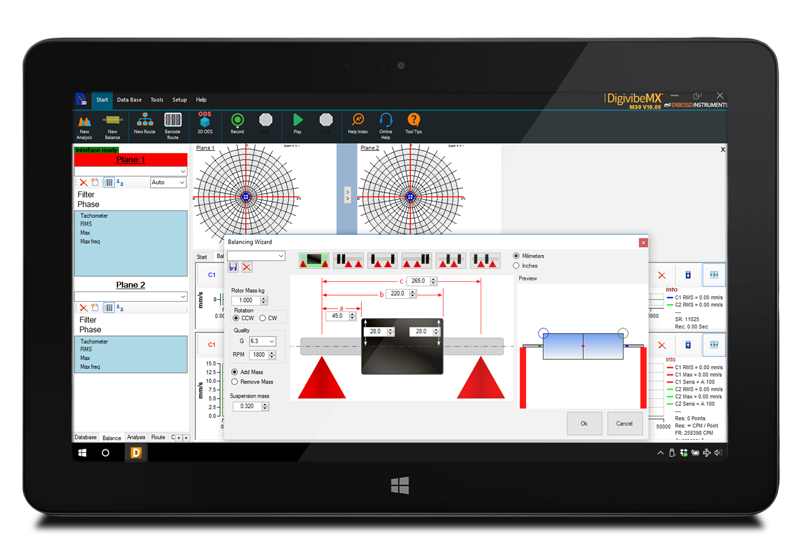
MX10 Balancer
The MX10 Balancer is one of the best balancers in the world. Competitive advantages of this device compared to others include ready-made templates for various **Overhung** and **Between-Bearing** rotors.
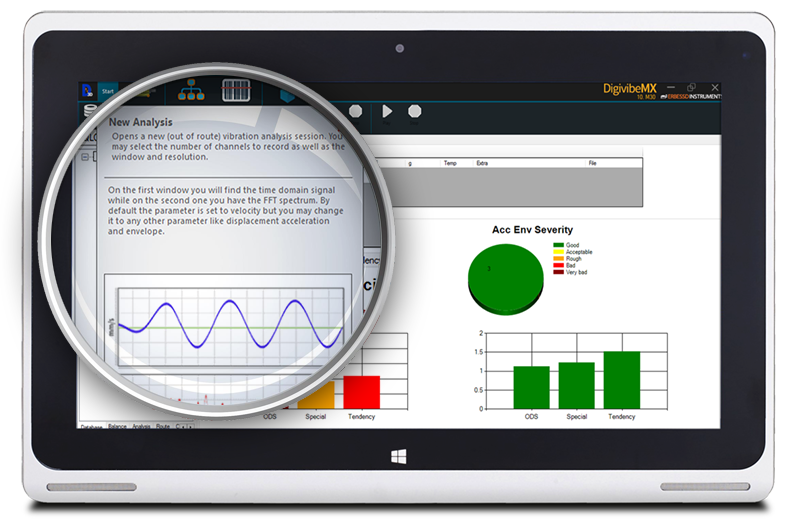
MX20 Data Collector
The MX20 Data Collector is one of the best data collectors in the world. Its competitive advantages include ultra-fast data acquisition (capturing time, frequency, and envelope data in just 3 seconds). Additionally, the ODS capability in the MX30 equipment* is highly notable among other devices; ready-made models in this equipment allow users to easily select a similar model on-site next to the equipment, displaying the equipment’s ODS in less than 5 minutes.
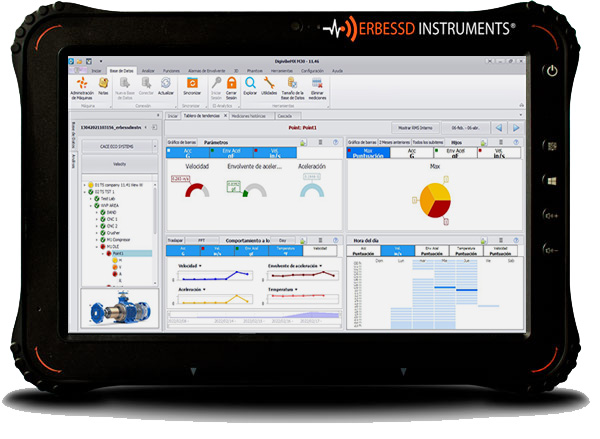
MX30 Data Collector and Balancer
The MX30 Data Collector and Balancer is one of the best data collectors and balancers in the world. Its competitive advantages include ultra-fast data acquisition (capturing time, frequency, and envelope data in just 3 seconds). Additionally, the ODS capability in the MX30 equipment is highly notable among other devices; ready-made models in this equipment allow users to easily select a similar model on-site next to the equipment, displaying the equipment’s ODS in less than 5 minutes.
What are the reasons for using Modal Analysis and Testing?
Modal analysis is the study of the dynamic properties of linear structures based on structural testing or Finite Element Analysis (FEA) simulation. These dynamic properties include resonance frequencies (also called “natural frequencies” or “eigenfrequencies”) and structural modes (or “eigenmodes”). Dynamic properties depend on mass, stiffness, and damping distribution across the structure and determine the vibration behavior of the structure when exposed to operational loads.
Every deformation of a linear structural system can be expressed as a linear combination of structural modes, forming a canonical vector basis.
Modal testing combines data collection with further analysis. In an industrial application, the complete process is often referred to as Modal Testing and Analysis or Experimental Modal Analysis (EMA).
The results of modal testing and analysis are used in various simulation and testing applications, including vibration response calculations, Root Cause Analysis (RCA) of vibration problems, and damage detection. They are also used to add flexibility to multi-body analysis and to accelerate durability and vibro-acoustic simulations. Modal-based calculations are highly effective and allow for the efficient assessment of structural changes regarding responses.
What is the application of Modal Analysis Testing?
Modal analysis characterizes the deformation of a structure due to external vibration inputs. When a structure is excited by external vibrational energy, it deforms in a number of well-defined wave-like patterns or modes. Each mode has its own natural frequency, mode shape, and damping coefficient.
Modal properties are determined by exciting the structure with random vibration and measuring the response at a set of test points using a Fast Fourier Transform (FFT) analyzer. Sophisticated software then processes the experimental data into a calibrated 3D map in either Imperial or Metric displacement units. The resolution of this technique is very high.
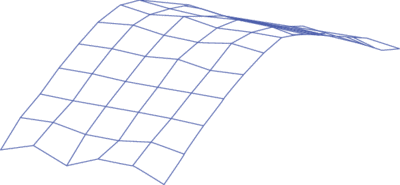
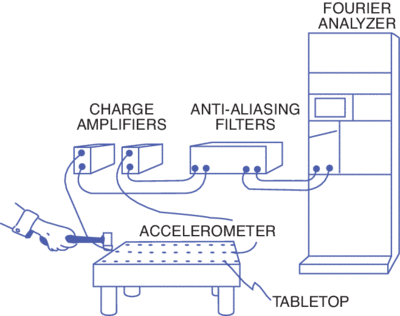
Typical setup for modal analysis testing. After signals are conditioned, they are digitized and processed by an FFT analyzer. Data is then relayed to a workstation to calculate the 3D modal plot.
Modal Analysis and Testing with Software
Our modal analysis service provides valuable tools to help you evaluate and meet your application’s vibration control requirements.
Modal Analysis:
- Experimentally measures actual displacement amplitudes across the entire work surface.
- * Simulation of your unique equipment settings allows for the investigation of different placement options for best performance.
Modal analysis takes the concept of relative motion a step further by providing a 3D graphical representation of displacements on the table top or the entire work surface. In addition to providing direct experimental proof of vibration isolation and structural performance, modal analysis identifies “sweet spots” within the structure. Pinpointing these locations, where the work surface motion amplitude is lowest, reveals the best locations for placing critical equipment to achieve the highest stability and performance.