
Despite the availability of various motor repair and current analysis tools used to achieve a high degree of reliability and performance monitoring of induction motors, companies have continued to struggle with major issues such as reduced motor lifespan and unforeseen system failures. Several condition monitoring methods exist, such as thermal monitoring and vibration monitoring, which require expensive sensors, whereas current monitoring does not require any additional sensors.
The condition monitoring industry has extensively used vibration analysis for years. The use of induction motors in industrial drives is very common because they are reliable and cost-effective. In fact, they have become the workhorses of the industry, playing a crucial role in converting electrical energy into mechanical energy. Since ensuring safe operation heavily depends on proper maintenance, fault diagnosis, and operational reliability, many traditional techniques and tools are used to monitor induction motors. Therefore, let us first understand Motor Current Signature Analysis (MCSA) and see how it plays a vital role in revolutionizing the condition monitoring industry.
Motor Current Analysis Devices
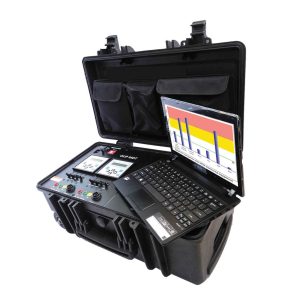
Olip MDT (Artesis AMT) Current Analyzer
The **Olip MDT (Artesis AMT)** device is capable of diagnosing various types of three-phase constant and variable speed motors, induction motors, synchronous motors, and generators across low, medium, and high voltage ranges. For its analysis, it utilizes three current and voltage sensors that are easily installed.
This device also possesses the capabilities of a fully professional power analyzer. Moreover, a complete mechanical, electrical, and partial discharge test of a machine using the MDT takes approximately one hour, effectively allowing the operator to perform between 5 to 7 tests per day. This test time can be reduced depending on the parameters selected by the operator for data acquisition.
Ultimately, using its professional software, the MDT package provides comprehensive information on harmonics (up to the 13th order). Common mechanical and electrical faults identifiable by this device include:
[List of identifiable faults would follow here as implied by the context, though the source text transitions to the next device description.]
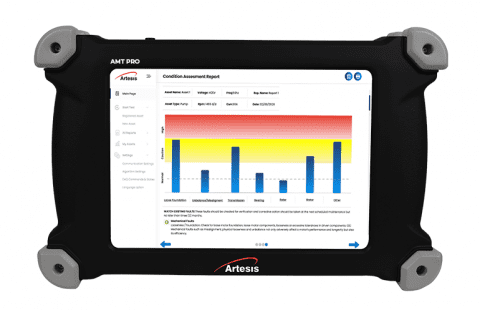
Artesis AMT Pro Current Analyzer
The **AMT Pro** device is compatible for analyzing three-phase AC constant and variable speed motors, generators, compressors, fans, pumps, conveyors, and motorized equipment.
- * Automatic troubleshooting
- * Instant report generation with diagnostic information
- * Advanced spectrum display and current waveform analysis
- * Access to applications
- * Integration via Wi-Fi
- * Short test time (7 minutes)
- * Simple and easy test setup
- * Online motor testing
- * Portable, internal battery
How does Motor Repair and Current Analysis detect fault frequencies?
Let’s consider an example of an electrical current signal received from the motor’s power supply without disrupting the machine’s operation. In Motor Current Signature Analysis (MCSA), the frequency spectrum (known as the current signature) is obtained by processing the current signal. In the event of a fault, the frequency spectrum differs from that of a healthy motor.
Induction motor fault detection and condition monitoring are achieved through signal processing techniques because signal processing is a cost-effective technique and very easy to implement. Furthermore, MCSA implementation aids in precise fault analysis.
To identify exclusive motor current signature patterns and provide a wider dynamic range of various faults, the Decibel (dB) unit versus frequency spectrum is used. This technique helps identify faults such as stator faults, rotor slip, bearing faults, and eccentricity, or a combination of these faults may be revealed through motor current signature analysis.
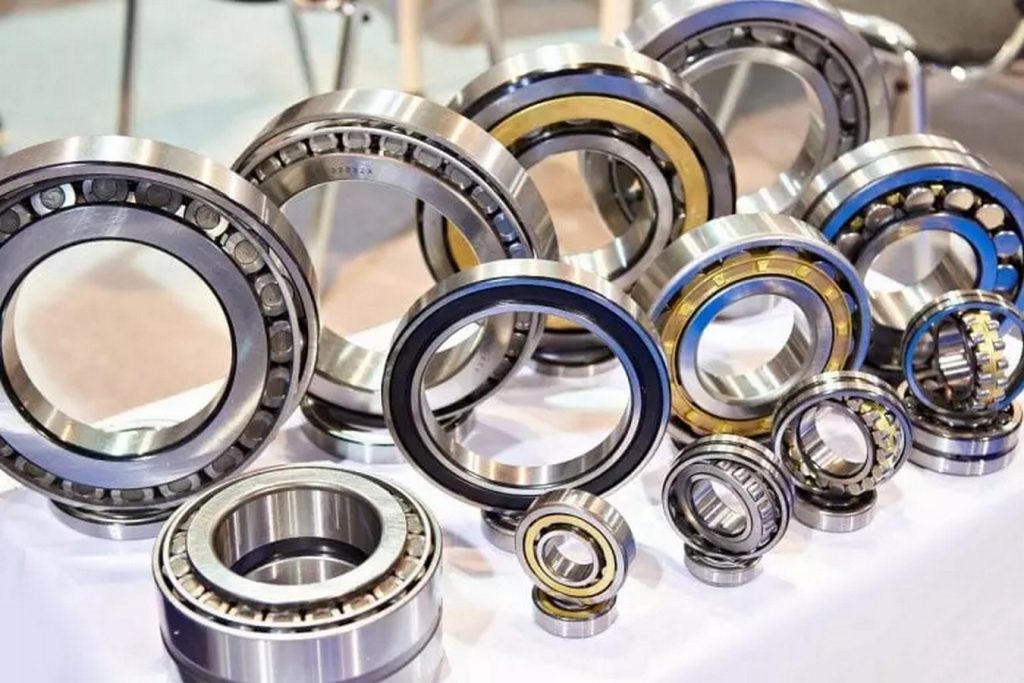
What faults can Motor Repair and Current Analysis detect?
Bearing Fault Identification via Motor Signal Current Analysis
When operating conditions are normal and there is a balance between good alignment and load, failures caused by motor fatigue usually start with small cracks. This means they spread slowly until they begin to create significant vibration and noise levels. Understandably, detecting motor bearing faults is not easy for various reasons, such as misalignment. This is where MCSA comes into play to identify faults by detecting frequency components – (low frequency) and (high frequency).
Broken Rotor Bar Identification via Motor Signal Current Analysis
We know that specific induction motors face the issue of broken rotor bars due to arduous duty cycles, but this does not immediately cause induction motor failure. However, they can lead to other damages. For example, the fault mechanism can break parts, causing mechanical damage and winding failure, which directly impacts production and leads to expensive repairs.
Air Gap and Eccentricity Identification via Motor Signal Current Analysis
This fault causes the air gap length to not remain constant with respect to time and the stator circumference angle. This happens when there is no uniform air gap between the stator and the rotor. There are three types of air gap eccentricity: Dynamic, Static, and Mixed eccentricity.
The Role of Motor Current Analysis in Revolutionizing the Condition Monitoring Industry
Electric Submersible Pumps (ESPs) are a perfect example of the importance of Motor Current Signature Analysis (MCSA) in changing the face of the condition monitoring industry. Since ESPs play a fundamental role in oil and gas operations, they are considered one of the most adaptable options because when a reservoir does not have enough energy to produce oil, an economical lifting method is needed to increase fluid flow.
However, harsh conditions in some pumps mean pump reliability is compromised. Consequently, ESP failures occur due to the presence of fine rock particles, sudden changes in well conditions, the presence of gas, and even temperature increases. Given that ESPs started to fail due to many external and internal factors directly affecting production, there was a need for a solution that could mitigate risks.
This is where Motor Current Signature Analysis (MCSA) stepped in as an excellent solution because it analyzes current and voltage data using advanced algorithms and helps in the early detection of problems to prevent any damage.

With the introduction of MCSA, previous ESP condition monitoring tools no longer seem as effective because the MCSA system can be installed in the motor control cabinet (the ideal environment for the system to accurately mitigate risks). What makes MCSA so effective is its ability to collect data regardless of operating conditions. Hence, MCSA ensures there are continuous streams of high-quality data.
Now let’s discuss anomaly detection algorithms in ESPs and how to inspect each motor and pump. However, with MCSA, there is no need to check every pump for manual inspection because the engineering team can easily monitor hundreds of pumps.
The MCSA-based system has simply eliminated the laborious and painstaking process of manually inspecting each motor and pump. Anomaly detection algorithms also indicate which pumps are not working correctly.
This helps the motor repair and current analysis team focus on pumps that need immediate repair. Furthermore, it also indicates the root cause of the problem.
It should be noted that the contracting unit of **Noavaran Payesh**, operating from a separate office with over 10 years of experience, and holding ranking qualifications, Knowledge-Based status, Labor Department certification, and safety certifications, is ready to provide valuable services to the Oil, Gas, and Petrochemical industries, and is prepared to offer motor repair and current analysis services.
This company is ready to provide **Motor Current Analysis** services to identify all electrical and mechanical faults in industrial equipment such as motors, generators, downhole pumps, etc.